Understanding your true strength potential is a key part of effective training, and the Single Rep Max Calculator is one of the best tools to help you achieve that. Whether you’re a beginner lifter or an advanced athlete, knowing your one-repetition maximum (1RM) allows you to train smarter, track progress accurately, and prevent injuries. This guide will explain everything you need to know about the single rep max calculator — how it works, how to use it, and why it matters for performance and safety.
What Is a Single Rep Max?
A Single Rep Max (1RM) refers to the maximum amount of weight you can lift for one complete repetition of an exercise, such as a squat, bench press, or deadlift, while maintaining proper form. It is a fundamental measure of your maximum strength and provides a foundation for setting percentages in training programs.
For example:
If your 1RM on the bench press is 100 kg, you might perform training sets at 70–80% of that weight for multiple repetitions to build strength effectively.
Why Knowing Your 1RM Is Important
Understanding your one-repetition-maximum is more than just knowing your limits — it’s about training intelligently. Here are a few reasons why every serious lifter or coach should use it:
- Personalized Training Intensity:
Your 1RM helps determine the right load for different training goals — strength, hypertrophy, or endurance. - Progress Tracking:
Monitoring changes in your 1RM over time shows whether your training program is effective. - Injury Prevention:
Training above your capacity increases the risk of injury. Knowing your limits ensures safe progression. - Program Design:
Many structured programs like 5/3/1 or strength blocks use 1RM percentages for progression and load management.
How a Single Rep Max Calculator Works
A Single Rep Max Calculator uses mathematical formulas to estimate your 1RM based on the weight you lifted and the number of reps completed. This means you don’t have to attempt a true maximal lift, which can be risky, especially without supervision.
Common 1RM Formulas
Several equations exist to estimate your 1RM, including:
Epley Formula
1RM = Weight × (1 + 0.0333 × Reps)
Brzycki Formula
1RM = Weight × (36 / (37 – Reps))
Lombardi Formula
1RM = Weight × (Reps ^ 0.10)
Each formula gives a slightly different estimate, but all are close enough for practical use. Most online calculators use the Epley Formula as it’s accurate for 1–10 rep ranges.
Example of a 1RM Calculation
Let’s say you performed 5 reps of 80 kg on the squat.
Using the Epley Formula:
1RM = 80 × (1 + 0.0333 × 5)
1RM = 80 × 1.1665
1RM = 93.32 kg
So, your estimated 1RM for squats would be 93.3 kg.
From here, you can calculate percentages of your 1RM to plan your training.
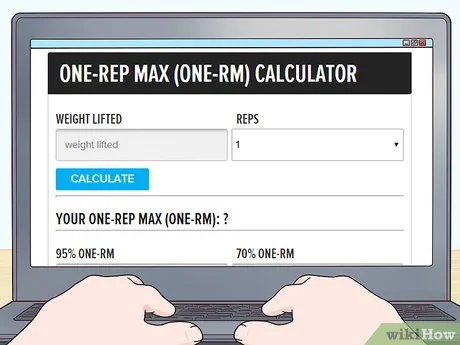
How to Use a Single Rep Max Calculator
Using the calculator is quick and easy:
- Enter the weight lifted – the amount of weight you used for your set.
- Enter the number of reps – how many repetitions you performed before reaching fatigue.
- Click calculate – the tool will display your estimated 1RM instantly.
Once you have your 1RM, you can use it to determine your training loads for various goals:
- Strength building: 85–95% of 1RM
- Hypertrophy (muscle growth): 65–80% of 1RM
- Endurance: 50–65% of 1RM
Benefits of Using a Single Rep Max Calculator
- Safety First:
It eliminates the need to perform an actual max attempt, reducing injury risk. - Efficiency:
You can find your 1RM anytime without needing a heavy test day. - Progressive Overload:
The calculator helps you plan incremental load increases based on accurate data. - Consistency:
Regularly estimating your 1RM provides a consistent benchmark for progress tracking.
Integrating RPE with 1RM Calculations
For advanced training precision, some calculators combine the Rate of Perceived Exertion (RPE) scale with 1RM estimation.
The RPE method allows you to account for daily fluctuations in performance caused by fatigue, recovery, or stress.
For example:
If you lifted 80 kg at 8 RPE (2 reps left in the tank), your estimated 1RM might adjust based on effort — providing a more realistic number than a fixed formula.
This integration helps create auto-regulated programs, making your training more adaptive and personalized.
Common Mistakes to Avoid When Using 1RM
- Poor Form:
Estimating your 1RM based on sets with bad form leads to inaccurate results. - Too Many Reps:
The formulas are less accurate above 10 reps, so use sets with fewer repetitions for better accuracy. - Ignoring Warm-up:
Always perform a proper warm-up to ensure optimal muscle performance. - Using Old Data:
Update your 1RM regularly — at least every 4–6 weeks — to reflect your current strength level.
When to Test or Update Your 1RM
Recalculate or retest your 1RM:
- After completing a strength cycle.
- When you notice lifts feeling easier at the same load.
- Following a deload or recovery phase.
Tracking changes over time gives valuable insight into your training progress and helps adjust future goals.
Tools and Resources for Accurate Results
To simplify your calculations, you can use our Single Rep Max Calculator — a free, easy-to-use online tool designed for precision and safety.
Try it now: Use the Single Rep Max Calculator
This calculator provides instant, accurate estimates for major lifts and supports RPE-based adjustments to fine-tune your training load.
Final Thoughts
The Single Rep Max Calculator is a vital resource for anyone serious about improving strength performance. It removes the guesswork from training, ensures safe progression, and helps structure effective programs based on science, not estimation.
By understanding and using your 1RM, you gain better control over your workouts, recovery, and long-term progress. Whether you’re a powerlifter, athlete, or general fitness enthusiast, mastering your 1RM through an accurate calculator will lead to smarter, safer, and stronger training outcomes.